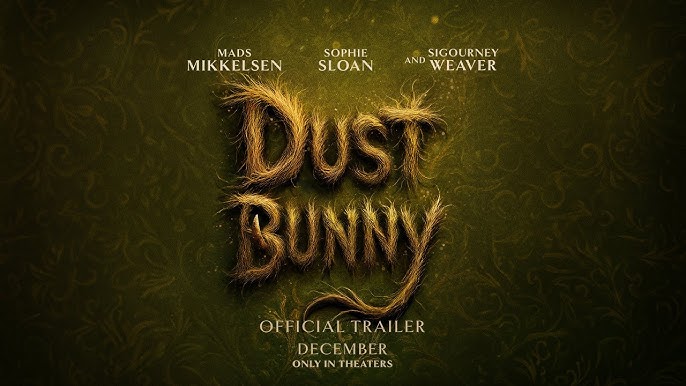
Dust Bunny (2025) — Full Review of Bryan Fuller’s Dark Fairy-Tale Horror
Introduction
Dust Bunny (2025) marks the feature directorial debut of Bryan Fuller, known for his stylish, macabre storytelling in television. The film stars Mads Mikkelsen, Sophie Sloan, Sigourney Weaver, David Dastmalchian, and Sheila Atim, and runs a tight 106 minutes. Blending horror, fantasy, and psychological thriller, Dust Bunny explores childhood terror through a grotesque fairy-tale lens.
Premiering at the Toronto International Film Festival before its wide release, the film immediately positioned itself as one of 2025’s most distinctive genre entries, mixing surrealism with grounded emotional drama.
This review breaks down the film’s full narrative, themes, performances, direction, strengths, weaknesses, and final verdict — crafted for SEO and film-criticism depth.
Plot Synopsis
Dust Bunny revolves around Aurora, an eight-year-old girl whose life is shattered when a monstrous creature living under her bed devours her family. The terrifying incident is dismissed by adults as trauma-induced hallucination, but Aurora clings to the truth she witnessed — a truth that has left her orphaned and alone.
Across the hall lives a mysterious, reclusive hitman known only as Resident 5B (Mads Mikkelsen). Aurora observes the man’s cold efficiency and violent skillsets, eventually deciding he may be her only hope. One night, she musters the courage to knock on his door and makes an unthinkable request:
“I need you to kill the monster under my bed.”
At first, the hitman assumes that Aurora’s family was murdered by assassins targeting him. Yet her unflinching detail of the creature sparks doubt. He reluctantly agrees to a “reconnaissance mission” to appease her, convinced her trauma is masking a human threat.
But as killings mount and the presence under Aurora’s bed becomes increasingly real, the hitman is forced into a surreal confrontation where fantasy and reality blur. While assassins circle around him, the “dust bunny” — an eldritch creature feeding on grief — emerges as a terrifying physical force.
The film escalates into a violent, dreamlike battle through apartment corridors, shadow-filled spaces, and ever-twisting psychological landscapes. Aurora and Resident 5B become unlikely partners — a child burdened by loss and a man hardened by violence — each seeking a sense of redemption amid the carnage.
Critique & Analysis
A Dark Fairy-Tale Wrapped in Horror
Dust Bunny distinguishes itself by refusing to sit comfortably within a single genre. While its horror elements are pronounced, the film operates through fairy-tale logic, leaning into symbolism and childhood perspectives.
The monster under the bed is both literal and emotional — an embodiment of Aurora’s grief, fear, and the chaos that consumes her life. Fuller uses this as the narrative engine, creating a story where the fantastical feeds directly off psychological trauma.
This blend of emotional sincerity and grotesque whimsy feels reminiscent of Pan’s Labyrinth or Coraline, but with Fuller’s signature macabre flair.
Themes
• Childhood Trauma Made Manifest
Aurora’s terror is not metaphorical — the creature exists in the film’s diegesis — but Fuller reinforces that the monster is intertwined with psychological pain. Horror becomes the visual language of grief.
• Proxy Parenthood & Surrogate Bonds
The relationship between Aurora and the hitman becomes the film’s beating heart. Their reluctant partnership evolves into something deeply human: a fractured adult trying to protect a shattered child.
• The Violence of Survival
Resident 5B’s world of assassination collides with Aurora’s nightmare realm, merging two forms of violence — literal and emotional. The contrast highlights how destruction permeates both adult and child experiences.
• Reality vs. Imagination
The film intentionally destabilizes the viewer’s certainty. Scenes are framed through Aurora’s perspective, inviting questions about perception, fear, and truth.
Performances
Mads Mikkelsen as Resident 5B
Mikkelsen is perfectly cast as the stoic, lethal neighbor drawn into a child’s war against darkness. His performance balances detachment and vulnerability, grounding the film’s stranger elements. Without him, the film might tilt into absurdity; with him, it remains emotionally anchored.
Sophie Sloan as Aurora
A standout performance. Sloan captures innocence, trauma, and bravery with maturity beyond her years. Her dynamic with Mikkelsen is the film’s emotional core and never veers sentimental or exaggerated.
Sigourney Weaver
Weaver plays a cold, domineering handler figure within the assassin network. Her scenes add menace, structure, and adult-world stakes to the narrative.
David Dastmalchian & Sheila Atim
Both actors contribute memorable supporting roles — Dastmalchian as an unstable assassin hunting Resident 5B, Atim as a social worker whose motives become murkier as Aurora’s story unfolds.
Direction & Style
Bryan Fuller’s direction is bold, stylized, and unapologetically imaginative.
Visual Design
The film employs:
-
exaggerated shadows
-
gothic-fairy lighting
-
color-graded palettes shifting between cold violence and warm childhood memory
-
warped interiors that subtly distort over time
The combination creates a world that feels trapped between two realities — grim adulthood and surreal childhood fear.
Creature Design
The “dust bunny” itself is unsettling: a contorted mass of fur, teeth, and exaggerated childlike proportions. Its design feels both whimsical and nightmarish, fitting perfectly into the film’s fairy-tale-horror tone.
Pacing & Structure
Fuller builds tension gradually, favoring atmosphere over jump scares. The midpoint turns the film into a violent crescendo, culminating in a finale that embraces full surrealist horror.
Sound & Music
The sound design is crucial — low rumbles, scuttling under the bed, breathy distortions. The score blends eerie lullabies with brooding orchestral notes, reinforcing the film’s tone.
Screenplay
The script is ambitious, balancing:
-
emotional depth
-
symbolic horror
-
genre action
-
fantastical storytelling
Dialogue is understated, allowing visuals and performance to carry emotional weight. The screenplay’s biggest strength lies in its character dynamics and thematic cohesion.
However, it occasionally stretches itself thin, leaving certain secondary characters under-explored.
Strengths & Weaknesses
Strengths
-
Unique premise — a bold spin on the childhood-monster trope
-
Emotional core — strong bond between Aurora and Resident 5B
-
Striking visuals — surreal, gothic, nightmare-fairy-tale aesthetic
-
Powerful performances — especially Mikkelsen and Sloan
-
Layered themes — grief, trauma, protection, and the monstrous
Weaknesses
-
Tonal shifts occasionally abrupt
-
Some supporting roles underdeveloped
-
Pacing may feel slow to viewers expecting conventional creature horror
-
Fantasy elements can overshadow plot clarity
Final Verdict
Dust Bunny is not a traditional horror film — it is a dark fairy-tale that uses genre elements to explore trauma and the need for protection. Bryan Fuller’s debut is visually rich, emotionally resonant, and stylistically daring. Though imperfect in its tonal balance and character depth, the film offers a rare blend of heart and horror.
Backed by stellar performances and a striking imaginative vision, Dust Bunny stands as one of 2025’s most unusual and memorable genre films.
Rating:
A bold, atmospheric, emotionally charged horror-fantasy — imperfect but unforgettable.